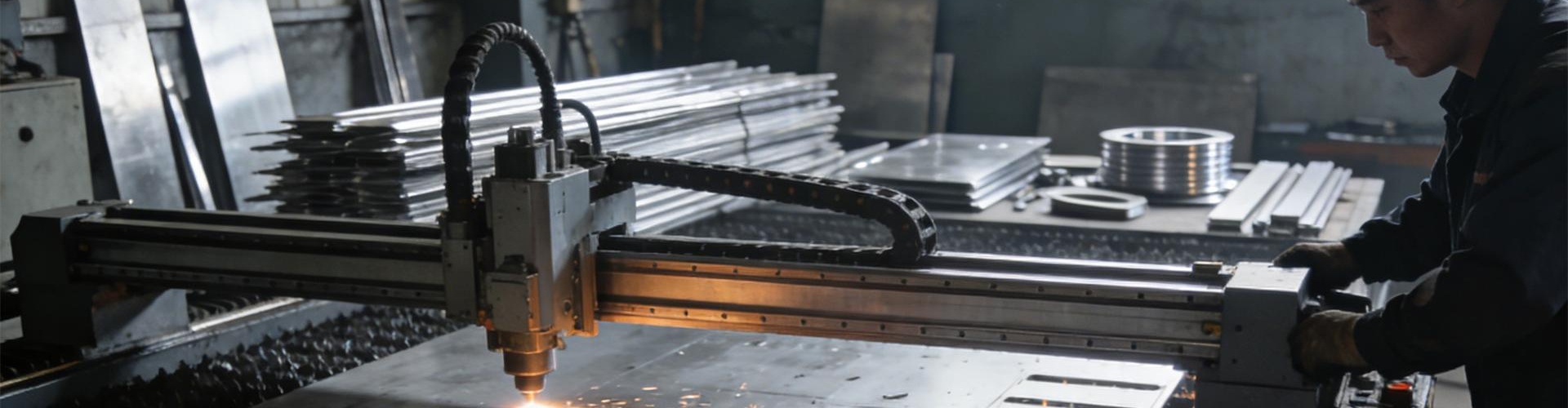
Laser-welded precision stainless steel tube is thin-wall tube rolled from strip and joined with a focused laser beam. The beam gives you a narrow heat-affected zone, very little distortion, and dimensional control that high-speed TIG welding can't touch. On walls between 0.2 and 2.0 mm, the beam concentrates its energy into a spot a few tenths of a millimeter across, so the fusion line stays fine, the bead sits nearly flush, and outside-diameter and wall tolerances hold steady at line speeds of 20-80 m/min. At Zhejiang Wenqiang Stainless Steel Co., Ltd. we run this route for 304/304L, 316/316L, and 321 precision tube headed for instrumentation, medical, and heat-exchanger service.
Laser Welding Versus Conventional TIG
Energy density is what separates the two. A TIG arc spreads its heat over a wide area, so on thin wall the operator has to slow down or punch straight through, and the metal around the joint sits above the sensitization range longer than anyone would like. A laser drops a high power density into a tiny spot and finishes the weld in milliseconds per unit length. In practice that means a heat-affected zone 2-4 times narrower than TIG, far less heat per meter, and less grain coarsening next to the seam.
Lower heat input also keeps chromium-carbide precipitation in check. Hold 304 between roughly 425 and 815 degrees C and chromium starts pairing with carbon at the grain boundaries, robbing those boundaries of the chromium that fights corrosion. The laser races through that range and heats a smaller volume, so the sensitized zone stays small, which counts for aggressive media and for polished tube where the surface has to stay intact. Specifying low-carbon 304L or 316L takes away more of the carbon that drives the reaction.
Achievable Tolerances
Precision here means predictability. Pair laser welding with sizing, and where needed cold drawing or bright annealing, and you can hold diameter and wall tightly enough for slip-fit assembly and repeatable instrument response. The figures below are typical; the exact numbers shift with size, alloy, and whether the tube is drawn after welding.
| Parameter | Typical Laser-Welded Capability | Why It Matters |
| Outside diameter | +/- 0.05 mm on small sizes | Slip-fit into fittings and bores |
| Wall thickness | +/- 8-10% or tighter when drawn | Consistent pressure rating and flow |
| Straightness | Under 1 mm per meter | Automated handling, clean bends |
| Surface Ra | 0.4-0.8 um after bright anneal | Cleanability, low fouling |
Right after welding, an in-line seam roll or planishing pass knocks down any leftover bead so the inside and outside sit close to flush. For the tightest work the welded tube is cold drawn over a mandrel, then bright annealed in a hydrogen or cracked-ammonia atmosphere to bring back ductility, give a clean oxide-free surface, and blend the weld into the parent metal.
Weld Integrity and Metallurgy
A good laser weld shows full penetration and a fine, even fusion zone: no lack of fusion, no porosity, no undercut. Autogenous laser welding usually runs without filler, so strip edge preparation and joint fit-up decide the outcome, and a gap larger than a fraction of the wall leaves underfill or misalignment. Shielding gas, argon or an argon-helium blend on top and inside the tube, keeps the molten pool from oxidizing and shapes the bead. Purge the bore and the inside surface stays bright, which high-purity and medical lines depend on.
The fast, fine solidification structure of a laser weld tends to land mechanical properties close to the base strip. Bright anneal it and the seam and parent metal form alike, so the tube bends, flares, and expands without splitting along the weld.
Applications Across Industries
Instrumentation lines feeding transmitters and analyzers need tight OD so compression-fitting ferrules bite the same way every time; laser-welded 316L tube gives that plus solid corrosion resistance. Medical and pharmaceutical equipment wants the smooth, cleanable bore and the option to polish down to a low roughness. Heat exchangers get thin, even walls that move heat well and stay leak-tight through cycling.
Thin-wall fluid and pneumatic lines for export markets like the process for a plain reason: it turns out long, consistent lengths at high productivity, so the cost per meter drops without losing the precision that automated downstream assembly needs. Where duplex 2205 is called for on higher strength and chloride resistance, laser welding still works, as long as heat input is controlled to hold the austenite-ferrite balance.
Food, dairy, and semiconductor lines pile on one more demand: cleanliness. The near-flush inside bead leaves fewer crevices for product or contaminants to lodge in, and the polished, bright-annealed bore shrugs off fouling and passivates easily. On fuel and cooling circuits in transport equipment, tight wall control keeps burst margins predictable across thousands of meters, so a designer can spec a thinner wall with confidence and take out weight without eating into the safety factor.
Quality Control at Wenqiang
Every precision tube order is backed by an in-house laboratory. We run positive material identification to confirm the alloy, chemical and mechanical testing to check composition and strength, and hydrostatic or pneumatic testing to prove the tube holds. Eddy-current testing runs in line to catch seam defects and pinholes as the tube moves, and dimensional inspection with laser gauges and micrometers checks OD, wall, and ovality against the order.
Documentation follows EN 10204 3.1 or 3.2 material test certificates as the order requires, and manufacturing lines up with ASTM A249 for welded austenitic tube and A269 for general service, under an ISO 9001 quality system. That trail lets buyers in regulated sectors show each lot meets specification, from heat number to final test.
Laser welding won't replace every joining method. But for thin-wall precision stainless tube it brings together a narrow heat-affected zone, high throughput, and tight tolerances in a way few other processes manage. Add cold drawing, bright annealing, and disciplined testing, and you get tube that assembles the same way every time and holds up in demanding fluid systems.
Frequently Asked Questions
Q: Is laser-welded tube as strong as seamless tube?
A: For most service pressures a properly laser-welded and bright-annealed tube performs comparably, because the fine weld and homogenized structure give near-base-metal properties; seamless is still preferred for the highest-pressure or most critical duties.
Q: What wall thickness range suits laser welding?
A: It excels on thin walls roughly 0.2-2.0 mm, where the narrow heat input avoids the burn-through and distortion that slow conventional TIG welding.
Contact Zhejiang Wenqiang for laser-welded precision tube quotes and specifications: +86 577 8922 2595 / https://www.chinawqsteel.com/

Copyright © 2026 Strongwin Stainless Steel Group Co., Ltd. All rights reserved. - Privacy Policy
 EN
EN
 Hot News